GEO vs local SEO: what changes when customers ask AI instead of Google
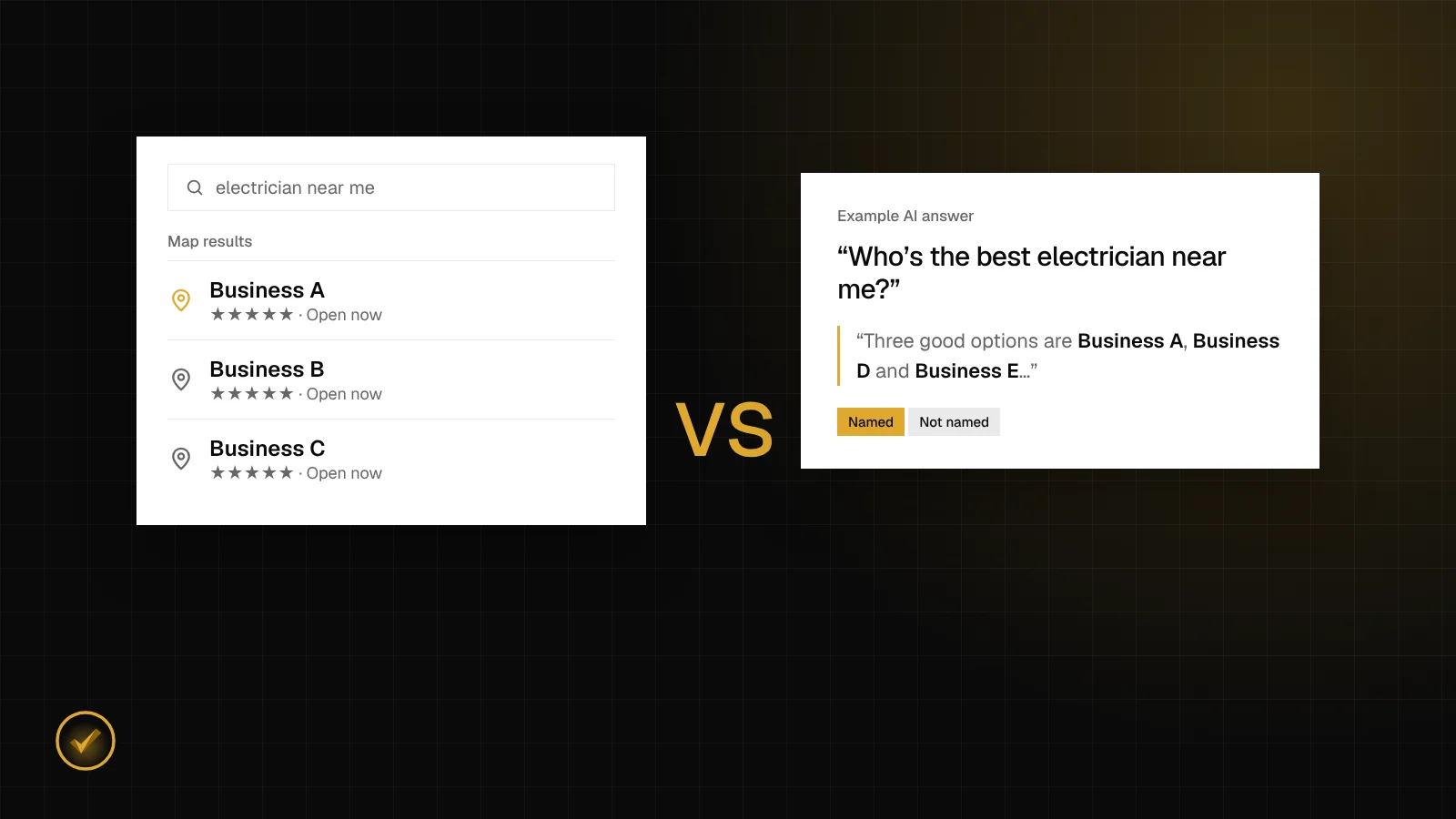
If you own a local service business, you've probably heard a new term lately: GEO. Someone's selling it, someone's saying SEO is dead, and you're left wondering whether you have to start over. You don't. Most of what gets you found on Google also helps you get named by AI. But a few things do change, and they're worth knowing before you spend a dollar or a weekend on it.
Here's a plain guide to what each one is, where they overlap, where they don't, and what we'd do first if it were our business.
What local SEO actually is
Local SEO is everything that helps you show up when someone near you searches Google for what you do. Think "plumber near me" or "roofer Andover MA". The results usually start with a map and three businesses under it, then a list of websites.
What moves you up there is mostly familiar stuff: a complete Google Business Profile, steady reviews, the same name, address and phone number on every directory, and a website that says clearly what you do and where. How close you are to the person searching matters too, and you can't change that.
The important thing about a Google search is that the customer still does the choosing. They see a list, they compare stars and photos, and they tap one. Being fourth isn't great, but you're on the page.
So what is GEO?
GEO stands for Generative Engine Optimization. You'll also hear "AI search optimization". It means helping AI assistants like ChatGPT, Claude and Gemini find you, understand you and name you when someone asks them for a recommendation.
Instead of typing "electrician Billerica" and scrolling, a customer asks a whole question: "Who's the best electrician in Billerica?" or "My breaker keeps tripping, who can come out today?" The assistant pulls together what it can find about local businesses and writes back an answer, usually with a few names in it.
Google does this now too. Plenty of searches show an AI-written answer at the top of the page, before the regular results. So even customers who never open ChatGPT are seeing AI pick businesses for them.
What stays the same
Here's the part a lot of people selling GEO skip: most of the work is the same. Google says as much. Its own guidance for site owners says the usual SEO best practices apply to its AI features, and there's no special extra step to get into them. Calling it GEO doesn't make the basics go away.
The things that help you on Google Maps also help you get named by AI:
- Your Google Business Profile. The right category, every service listed, the towns you cover, real hours and real photos.
- Reviews. A steady trickle of honest reviews, with replies from you.
- Consistent listings. The same business name, address and phone number on Google, Yelp, Facebook, BBB and the rest.
- A clear website. A page title and homepage that say what you do and where, so nobody (and no machine) has to guess.
When we asked AI who to hire for 147 local businesses, the ones it skipped were mostly missing these basics. 105 of the 114 we could check had a name, address or phone number that didn't match between their website and their directories. 90 of 121 had a homepage title that didn't say what they do and where. That isn't really an AI problem. It's an old-fashioned SEO problem that now costs you in two places instead of one.
What's different
The foundation overlaps, but what the customer sees at the end is different. Here's what we've noticed from asking these assistants a lot of questions.
AI names two or three businesses, not a list
On Google you can be number seven and still get a call from someone who scrolls. An AI answer usually names a handful of businesses and stops. If you're not one of them, you're not in the answer at all. There's no page two.
That's why our study came out so lopsided. We asked Claude who to hire 446 times for 147 local businesses around Billerica, Somerville and Andover, and a local business from our list was named only 4 times. Most answers went to national brands and franchises like CertaPro Painters, Orkin and Two Men and a Truck.
It quotes clear answers
AI assistants write in sentences, and they lean on sources that already say things plainly. A page that says "We're a licensed electrician serving Billerica, Chelmsford and Tewksbury. We do panel upgrades, EV chargers and service calls" is easy to repeat. A homepage that just says "Quality you can trust" gives it nothing to work with.
This is where FAQs earn their keep. In our study, 103 of the 127 businesses we could check had no simple answers to common customer questions anywhere on their site. Short, honest answers about what you do, where you go, how quickly you can come out and roughly what jobs cost are exactly the kind of thing an assistant can pick up and repeat.
"Best of" mentions count for more
When you ask an assistant for "the best" roofer somewhere, the answers seem to lean on what other people say about a business: reviews, local news, "best of" lists on local sites and directories. The big brands are mentioned everywhere, which goes a long way toward explaining why they get named so often. For a local shop, being included in a local "best of" list or written up on a town site can do more than you'd expect.
Answers change by assistant and by day
Google results move too, but slowly. AI answers can change from one day to the next, and ChatGPT, Claude and Gemini often give different names for the same question. One can name you while another doesn't. That's normal. It means you shouldn't panic over one bad answer, and you shouldn't celebrate over one good one either.
The two, side by side
| Local SEO | GEO | |
|---|---|---|
| Where customers see you | Google search results and Maps | ChatGPT, Claude, Gemini and Google's AI answers |
| How many businesses they see | A map with three, then a list | Usually two or three names in a written answer |
| Who narrows it down | The customer, from the list | The assistant, before the customer sees anything |
| What helps most | Profile, reviews, matching listings, a clear site | The same, plus clear answers and mentions on other sites |
| How fast it moves | Profile and listing fixes usually show within a few weeks | Usually several weeks to a couple of months |
| How steady it is | Fairly steady week to week | Varies by assistant and by day |
| How to check | Search and look at the map | Ask the questions and write down the answers, with dates |
What to do first
If you're deciding where to spend your time, here's the honest answer: don't pick one. Do the shared basics first, because they help on both. Then add the few things that carry more weight with AI.
- Fix your Google Business Profile. Pick the most specific category ("Electrician", not "Contractor"), list every service, set your towns and hours, and add photos from recent jobs.
- Make your name, address and phone match everywhere. Start with Google, Yelp, Facebook, BBB and Nextdoor. Fix or remove old listings with a previous number or address.
- Ask every customer for a review. Every job, every customer, nothing offered in return. A few new reviews a month beats a big batch once.
- Say what you do and where. Your homepage title should read like "Licensed Electrician in Billerica, MA", not just your company name.
- Add a short FAQ. Answer the questions you get on the phone, in plain words: cost ranges, how fast you can come, which towns, licensed and insured.
- Add LocalBusiness schema. It's a small block of code that spells out your name, phone, hours and service area for search engines and AI. In our study, 58 of the 60 sites we could check didn't have it.
- Go after local mentions. Ask to be included in local "best of" lists, join your chamber of commerce, and get listed on town and trade sites.
Steps 1 to 4 are classic local SEO. Steps 5 to 7 are where GEO adds weight. None of it is complicated, and none of it is a trick.
One thing we'd skip: anyone promising to get you "ranked #1 in ChatGPT". Nobody controls these answers, including us. What you can do is make your business easy to find, easy to understand and easy to trust. That's the whole job.
How to tell if it's working
For Google, your Business Profile shows you calls, direction requests and website clicks. For AI there's no dashboard like that, so you measure it the old-fashioned way: you ask.
Pick two questions a real customer would ask. One "best of" question, like "Who's the best plumber in Somerville, MA?", and one urgent one, like "I have a burst pipe, who can come out today in Somerville?" Ask ChatGPT, Claude and Gemini, each in a fresh chat. Write down the date, the exact answer, and who got named.
Then do it again next month: same questions, same assistants, same way. Because the answers move around, one check tells you very little. A few months of dated answers tells you a lot: whether you've started showing up, on which assistants, and who keeps getting named instead. We wrote a step-by-step guide for this: how to check what ChatGPT says about your business.
Keep your expectations honest while you wait. Profile and listing fixes usually show up within a few weeks. AI answers are slower to catch up, usually several weeks to a couple of months.